
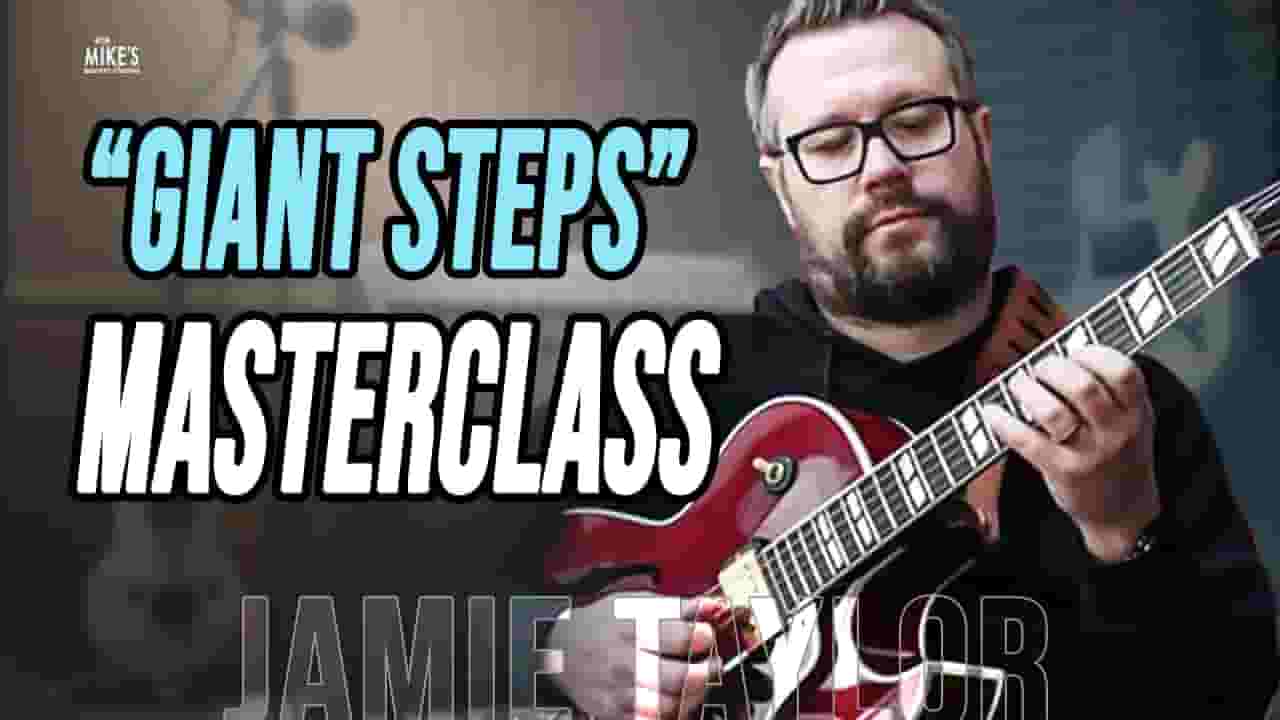
Soundsliced Masterclass
Anatomy of a Standard - "Giant Steps"
“Thanks again, Jamie! You present great information in your lessons here on Mike's Master Classes, and every bit of that information is immediately translatable into playing. Your…”
About this masterclass
Jamie Taylor takes the fear out of John Coltrane's Giant Steps with a focused 30-minute class built around two purpose-built etudes. Nearly sixty years on, this tune remains a rite of passage for improvisers — and while there's no way to simplify it, there are ways to unlock it. Think of this class as 'first steps' to Giant Steps.
In the full 30m33s class
- Two bespoke etudes demonstrated at different tempos, then broken down into specific line constructions
- Using triads as the primary visual and aural basis for lines — Jamie's paint-roller-to-fine-brush analogy for scales, arpeggios, and triads
- Harmonized scales as a means of improving fretboard knowledge, and how to connect triads with passing notes, sevenths, and chromaticism
- Practical pointers for memorizing the progression and melody — ascending minor thirds, descending half steps, and the two major-seventh arpeggios hidden in the melody
- The five melodic devices behind the second etude: seventh-chord arpeggios, chromaticism, enclosures, scalic movement, and tetrachords
- The note-counting practice technique, plus thoughts on phrasing and using silence
- Everything fully notated and tabbed in the accompanying 11-page PDF, with synchronized on-screen captions and synchronized Soundslice notation that follows the video performance
Musicians have played this tune in all keys and every kind of feel — some, like Kenny Garrett, intensifying it further; others, like Bill Frisell, transforming it into something more contemplative. It's probably not the first tune to tackle, but if you can play "Have You Met Miss Jones?", you're ready to have a go. The class is aimed mostly at the intermediate player who knows a few tunes and feels ready for the next challenge.
Lessons in this masterclass
Lessons
- 1Anatomy of a Standard - "Giant Steps”30m 33s
- 2Introduction1m 35s
- 3[Soundsliced] Giant Steps Etude 12s
- 4[Soundsliced] Giant Steps Etude 22s
- 5Closing Notes1m 20s
- 6Etude #1 - 120bpm1m 11s
- 7Etude #1 - 150bpm1m 2s
- 8Etude #1 - Explanation2m 4s
- 9Etude #2 - 120bpm1m 15s
- 10Etude #2 - 220bpm43s
- 11How to Connect Triads2m 21s
- 12How to Remember the Chords and Melody3m 35s
- 13Minor 2nds and Clarity Like a Bass Player1m 16s
- 14Note Counting Technique1m 4s
- 15Opening Performance1m 56s
- 16Paint to Surface Analogy and Triads4m 30s
- 17Perspective on the Etudes33s
- 18Phrasing and How to Use Silence1m 53s
- 19The 5 Different Melodic Devices4m 13s
Reviews & Ratings
"Outstanding way to break into Giant Steps"
Thanks again, Jamie! You present great information in your lessons here on Mike's Master Classes, and every bit of that information is immediately translatable into playing. Your approach to Giant Steps offers new insight and helps students understand how to see the song in triads that capture the fast-paced changes of the tune. Then, students learn how to use melodic devices to make lines that are more expressive without losing the underlying chord tones. With those foundations, the door is now open to creating great improves to this challenging Coltrane composition. Another fine lesson from a great instructor!
Related Courses
About the instructor
