
Harmonics Masterclass
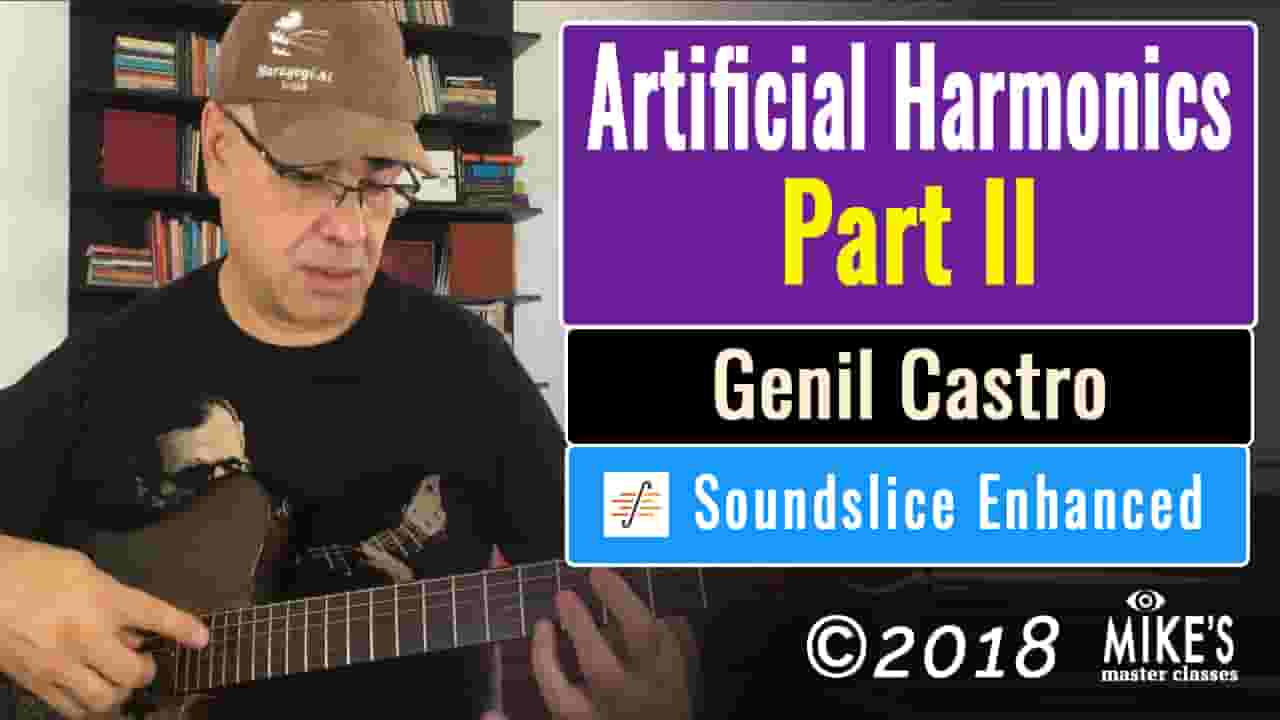
Expanding Guitar's Harmonic Vocabulary with Artificial Harmonics p. II
“Fantastic class! I first became aware of his music some years ago through Youtube, and when I saw this class being offered, I jumped at it without hesitation, and I'm glad I did.”
About this masterclass
Brazilian jazz guitarist Genil Castro continues his exploration of artificial harmonics, inspired by the playing of Lenny Breau. Where Part I covered the core technique, Part II gets into the finer points of what Genil calls the "electric lap piano": using harmonics to play closed, pianistic voicings that would otherwise be nearly impossible on the guitar.
What's covered
- Plurality — how one voicing can serve multiple harmonic functions, a concept Genil first found in Ted Greene's books
- How adding a harmonic transforms the voicing: understanding exactly which chord and inversion you're creating
- All four inversions of closed voicings — root position through third inversion — built from playable drop 2 and drop 3 shapes
- Chord alterations and extensions: turning major 7 chords into altered dominants and rootless extended voicings
- Bill Evans-style voicings and six-note melodic minor chords
- Voice-led major and minor II-V-I examples
- Putting it all together, with musical examples drawn from Stella By Starlight and My Funny Valentine
An essential continuation for anyone who studied Part I. Includes 17 pages of PDF materials in standard notation and TAB, plus Soundslice-enhanced versions of all written examples for looping and slow-down practice. Full video is 31 minutes.
Lessons in this masterclass
Lessons
- 1All PDF examples (Synthetic Audio) - Soundslice15m 5s
- 2Awareness of the Chord Being Created4m 48s
- 3Chord Alterations and Extensions5m 22s
- 4Expanding Guitar's Harmonic Vocabulary with Artificial Harmonics Part II31m 48s
- 5Introduction - Plurality3m 32s
- 6Inversions for Closed Voicings4m 47s
- 7Minor II V I Voicings3m 53s
- 8My Funny Valentine (Real Audio/Video) - Soundslice27s
- 9Opening Performance - Stella By Starlight1m 7s
- 10Putting It All Together and Conclusion4m 39s
- 11Using 6 Notes and Bill Evans Type of Voicings3m 41s
Reviews & Ratings
Fantastic class! I first became aware of his music some years ago through Youtube, and when I saw this class being offered, I jumped at it without hesitation, and I'm glad I did.
Related Courses
About the instructor
