
Jazz Guitar Masterclass
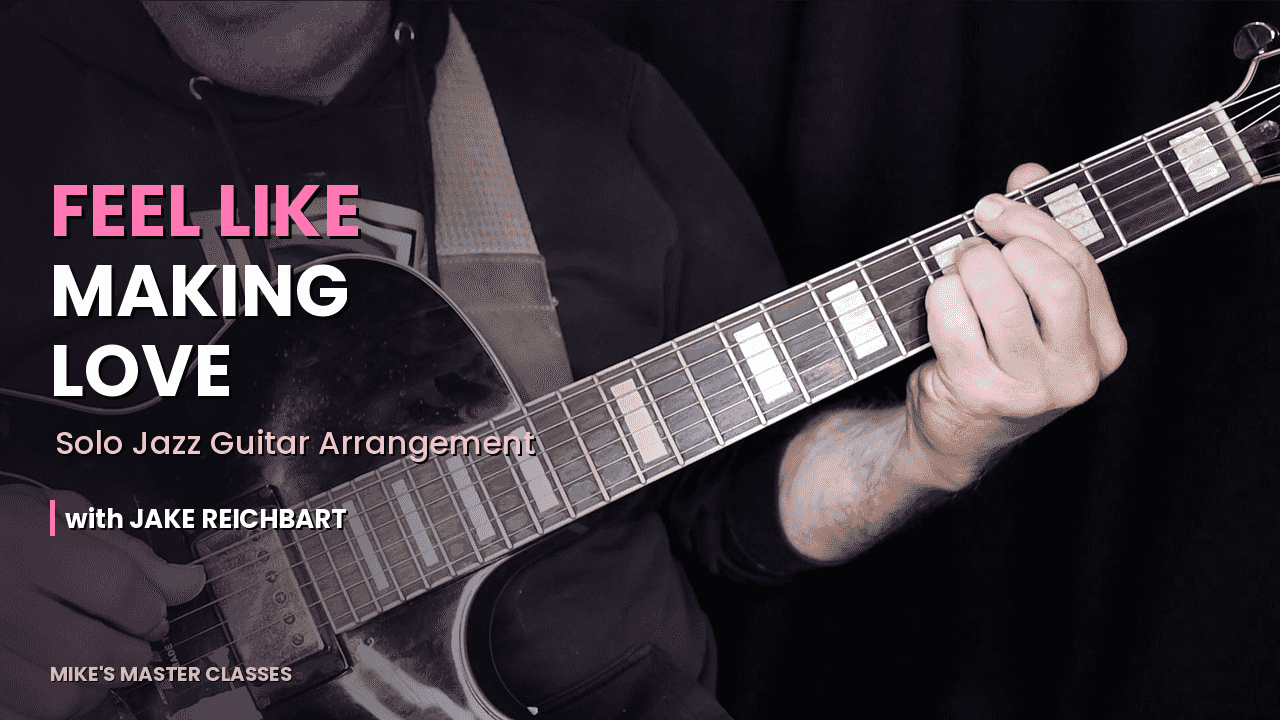
Feel Like Making Love: Solo Jazz Guitar Arrangement
About this masterclass
Some songs just feel good. And when you can play them solo—bass, chords, melody, groove, all from your own two hands—they feel even better.
In this comprehensive masterclass, Jake Reichbart breaks down his solo fingerstyle arrangement of Roberta Flack's timeless "Feel Like Making Love," teaching not just what to play, but how to make it groove. This isn't a note-for-note transcription exercise—it's a deep dive into the techniques and concepts that allow Jake to perform this tune night after night at his legendary 30+ year residency at The Earle, never playing it quite the same way twice.
The lesson is built around three pillars: playing the melody with its harmonies, creating rhythmic feel, and improvising over the changes. Jake's approach transforms your guitar into a complete band—and he'll show you exactly how.
The "Drum Kit" Concept:
Jake reveals how he thinks of solo guitar as representing an entire rhythm section:
- Thumb = Bass drum — steady quarter notes anchoring the groove
- Fingernail downstroke = Snare — percussive backbeat on 2 and 4
- Chord arpeggiation = Hi-hat — 16th note subdivision that keeps the engine running
In this lesson you will learn:
- How to play melody and bass as two independent rhythmic voices—the foundation of Jake's solo guitar approach
- The chord arpeggiation technique that fills rhythmic gaps and maintains forward momentum in the underlying 16th-note subdivision
- Jake's right-hand downstroke technique using fingernails for that percussive backbeat (and why you don't need acrylic nails to do it)
- Multiple voicings for the Bb11 suspended sound and how to navigate between them
- Using the Mixolydian mode with sharp 11 for color, plus blues inflections that maintain the major quality
- The tritone substitution (A7#11 for Eb7) and why it works
- How to approach improvisation by anchoring to localized chord shapes and exploring the notes available in each region
- Melodic minor applications: Lydian b7 and altered scale sounds over dominant chords
- Practical strategies for extending a short form—vamp introductions, playing the head twice with variation, and building density through improvisation
Jake works through the entire form slowly and in close-up, offering multiple fingering options for each passage and explaining the musical reasoning behind his choices. He demonstrates how small differences—a G played on one string versus another, a hammer-on borrowed from the original vocal—accumulate into a personal interpretation that honors the source while making it your own.
Whether you're building your solo repertoire, looking to understand how jazz harmony applies to R&B/soul standards, or simply want to sound like a complete band when you play alone, this lesson delivers the tools and the insight to make it happen.
Lessons in this masterclass
Main Lesson
- 1Feel Like Making Love - Complete Lesson1h 26m
Reviews & Ratings
No reviews yet. Be the first to review this course!
Related Courses
About the instructor
