
Chord Melody Masterclass
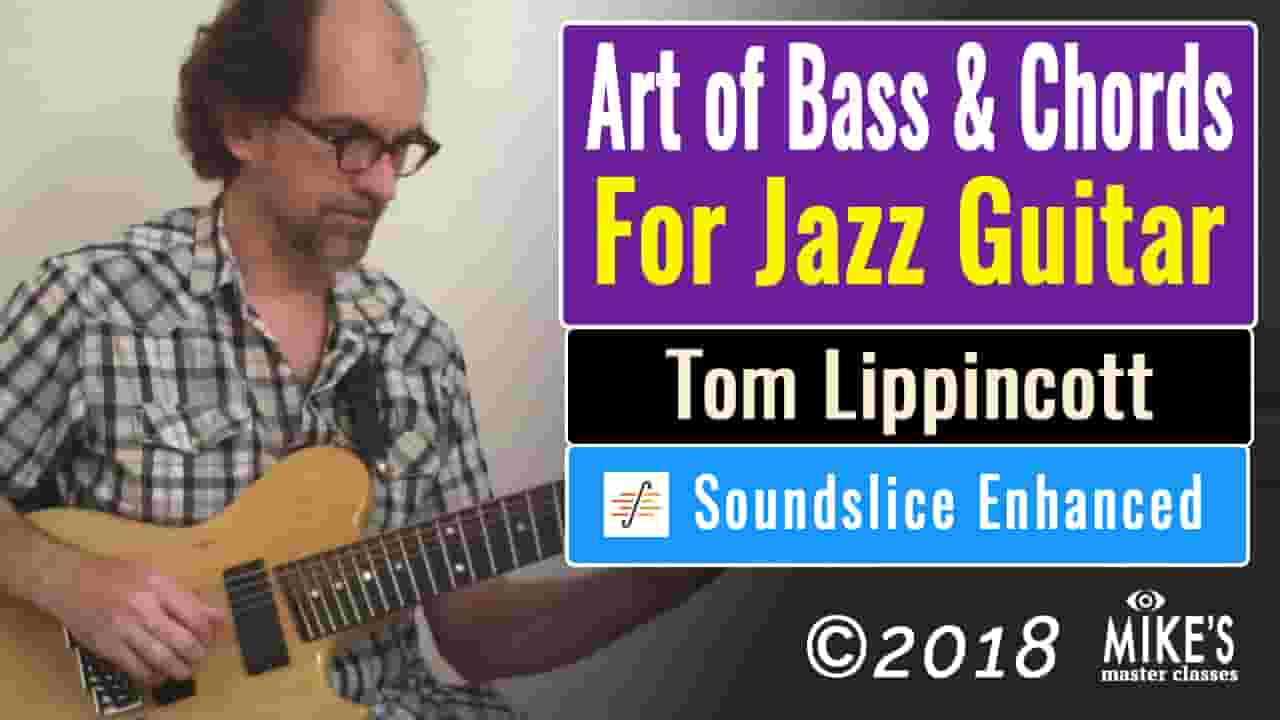
The Art of Bass & Chords For Jazz Guitar
“I find Tom’s classes are always full value for the money with excellent written materials and clear demonstrations and explanations on the video. This course is no exception and I…”
About this masterclass
Virtually all jazz guitarists are accustomed to the idea of staying out of the way of the bassist and/or the pianist in an ensemble setting. However, often in smaller settings, the guitarist must take on the roll of the pianist and bassist. While comping chords with the root in the bass and playing with rhythmic confidence can get the job done, a guitarist who has mastered the art of playing bass lines and comping chords simultaneously can add a whole new dimension to duos with a vocalist, a horn player, another guitarist, or many other configurations that lack a bass player. If you’ve ever wanted to be able to add bass lines and chords to your comping in different jazz settings, or if you have the basics down and want to bring your playing to the next level, this class is for you. Any guitarist attempting to play bass lines must realize the crucial importance of the bass role in an ensemble so we will first make a thorough study of creating bass lines in four different typical jazz styles and grooves: 4/4 walking swing tunes, jazz waltzes, jazz ballads, and bossa novas. We will next explore the addition of chords to each style, using primarily the simple but all-important shell voicings. This class offers a clear, systematic approach, helpful suggestions for gaining fluency with the concepts and the physical techniques, and plenty of examples and exercises for practice.
The Art of Bass and Chords for Jazz Guitar covers:
- five principles for creating strong bass parts
- three techniques for building walking bass lines
- techniques for one-chord-per-bar and two-chords-per-bar
- full length composed bass line on the chord changes of “Autumn Leaves” demonstrating different techniques
- bass lines on static chords
- upbeat notes and “chickety gongs” to enhance rhythmic drive and variety
- bass lines “in two”
- broken swing bass lines
- playing walking bass, “in one,” dotted quarters, and broken swing on jazz waltzes
- lyrical ballad approach
- basic bossa nova bass lines
- shell voicings for use with bass lines
- adding color tones/upper extensions to shell voicings
- discussion of right hand technique
- exercises for getting started combining chords and walking bass lines
- additional techniques for embellishing chord accompaniment to walking bass lines
- adding chords to bass lines “in two” and broken swing bass parts
- using half step approach chords and tritone substitute chords to harmonize bass lines
- using pedal tones with chords
- two full length real-world examples of walking bass and chord performances on “Autumn Leaves” and an F blues
- different techniques for adding chords to bass lines on jazz waltzes
- ballad approach combining bass and chords
- preliminary exercises for gaining rhythmic fluency and confidence for combining bass and chords on bossa novas
- full length example of bossa nova comping with bass on the chord changes to “Blue Bossa”
- additional examples of rhythmic variations for chord accompaniment
- 123 minute running time
- includes 30 pages of written examples and exercises
- All musical examples from the video are provided in music notation, tablature, and chord grid form.
- Each example performance is shown in close-up view and titled and numbered for easy navigation.
Lessons in this masterclass
Lessons
- 1The Art of Bass and Chords for Jazz Guitar2h 3m
- 2Introduction about the style and my guitar3m 51s
- 3Bass range, rhythmic value and good time4m 5s
- 4Metronome set slower2m 23s
- 5Note Choice and triads5m 35s
- 6Ex 2 and 33m 32s
- 7Ex 4 II V I in F Major and Chromatic Approaches6m 46s
- 8Two chords per bar and Autumn Leaves composed bass line5m 4s
- 9Example 9 Soundsliced1m 15s
- 10Ghost notes and Rhythmic Effects7m 4s
- 11Chickety gongs bass lines in two and broken swing bass lines7m 11s
- 12Strategies for faster tempos3m 10s
- 13Jazz waltz5m 49s
- 14Autumn Leaves9m 38s
- 15Ballads1m 39s
- 16Bossa Nova12m 15s
- 17Chords - Shell voicings4m 26s
- 18Chord - Adding Color Tones4m 59s
- 19Technique and combining chords and walking bass lines6m 39s
- 20Ex 29 The Charleston Rhythm and anticipation6m 46s
- 21Example 39 Soundsliced1m 15s
- 22Ex 40 F Blues3m 48s
- 23Example 40 Soundsliced57s
- 24Jazz Waltz5m 30s
- 25Ballads4m 39s
- 26Bossa Novas2m 34s
- 27Example 52 Soundsliced35s
- 28On my extended range guitar and outro performance7m 12s
Reviews & Ratings
5.0
2 reviews
5
2
4
0
3
0
2
0
1
0
Henry Rutgers
Verified Purchase
10/23/2019
"Very useful"
I find Tom’s classes are always full value for the money with excellent written materials and clear demonstrations and explanations on the video. This course is no exception and I now try to prepare a walking bass and chords arrangement to every song I learn.
Joshua Quintanilla
Verified Purchase
9/29/2019
"Thinking like a bass player. "
Still working through the course but have thoroughly enjoyed it thus far. A great resource for solo jazz guitar. Gives a guitarist like me a much-needed understanding of a bass player's perspective. A course on jazz counterpoint from Tom would be fantastic.
Related Courses
About the instructor

Tom Lippincott →
Eight- and six-string guitarist Tom Lippincott was born in New Jersey and grew up in Tulsa, Oklahoma, but has made South Florida his home since 1988. He has a bachelor's degree in jazz studies from the University of North Texas as well as a master's in jazz performance from the University of Miami. Tom teaches jazz guitar at Florida International University, Miami Dade College, and Broward College. He also teaches lessons in person and online, conducts clinics and workshops, and has jazz guitar courses available through Mike’s Master Classes. As a longtime contributor to the South Florida jazz community, Tom has played and recorded extensively with many of the area’s musicians and bands. He has also performed throughout the world as both sideman and leader and has performed and/or recorded with jazz luminaries John Stowell, Jonathan Kreisberg, Ben Monder, Dave Liebman, Don Friedman, and Ed Schuller. In addition to previous recordings such as his 2000 release Painting the Slow Train Brown, Tom has been featured as a performer and composer recently on David Fernandez’s Land, as well as the upcoming release from Rodolfo Zuniga’s band Surfaces with Strings featuring Camila Meza. Tom has a new album of original compositions, Twenty Years Later, available on his website at tomlippincott.com.