All Courses by John Stowell
41 coursesOdd Meter Strategies with John Stowell and Micky Lee
Description: By taking the class and practicing the ideas presented, the student will be able to... Better understand odd meter subdivisions and ways to phrase over the bar line in any meter. In this new class, John and Micky demonstrate subdivisions of odd meters (5/4,7/4,7/8,9/8, etc) and how to apply these meters to any song. Micky uses Macedonian folks melodies and a standard to demonstrate how he subdivides 7/8 and 9/8, and John plays several standards in 5/4 and 7/4 to discuss his concept of phrasing in those meters. John and Micky also demonstrate playing over the bar line to interpret odd meters more freely in soling and interpretation of melodies. Sub-topic 1: Voice leading in odd meter time signatures. Sub-topic 2: Different ways to subdivide phrases in odd meters Sub-topic 3: Benefits of odd meters to create phrases over the bar line in any time signature. Categories: Chord Voicings Mindfulness Modern Jazz Guitar Rhythm Theory Level: Advanced Duration: 56 Minutes
Modal Playing Strategies, Part 2 | John Stowell & Juan Dhas
Looking for an in-depth course covering new vocabulary available for playing over a major chord? Included are harmony references: Lydian, Lydian #9, and augmented-major chords. John and Juan use the bridge to “ Little Sunflower ” to demonstrate extensions of basic diatonic harmony in the keys of Eb and D major. In addition to modes of the melodic and harmonic minor that reference harmonic information for major chords, chord inversions and voice-leading are also demonstrated. Part 1: https://mikesmasterclasses.com/course/concepts-for-modal-playing-with-john-stowell-and-juan-dhas-part-1/ Sub-topic 1: Implied V chords Sub-topic 2: The use of chord inversions and shapes as templates for generating single-line solo ideas. Sub-topic 3: Comping strategies and voice leading ideas. CATEGORIES: Chord Voicings Harmony Modern Jazz Guitar Soloing Theory Level: Advanced
Concepts for Modal Playing with John Stowell and Juan Dhas, Part 1
In this class, John and Juan begin with some embellishments and triads derived from the Dorian mode played over a single minor chord. They then reference/demonstrate additional harmony that can be applied in a modal context. Some of the harmony covered is: major triads, melodic minor, implied V chords, the use of tension and release, and simple progressions/turnarounds superimposed over a single minor chord. Sub-topic 1 - Chord voicings as templates for single-line playing. Sub-topic 2 - Open string voicings Sub-topic 3 - Specific tension/release strategies. Categories: Chord Voicings Harmony Modern Jazz Guitar Soloing Advanced Duration: 43 Minute 28 Seconds
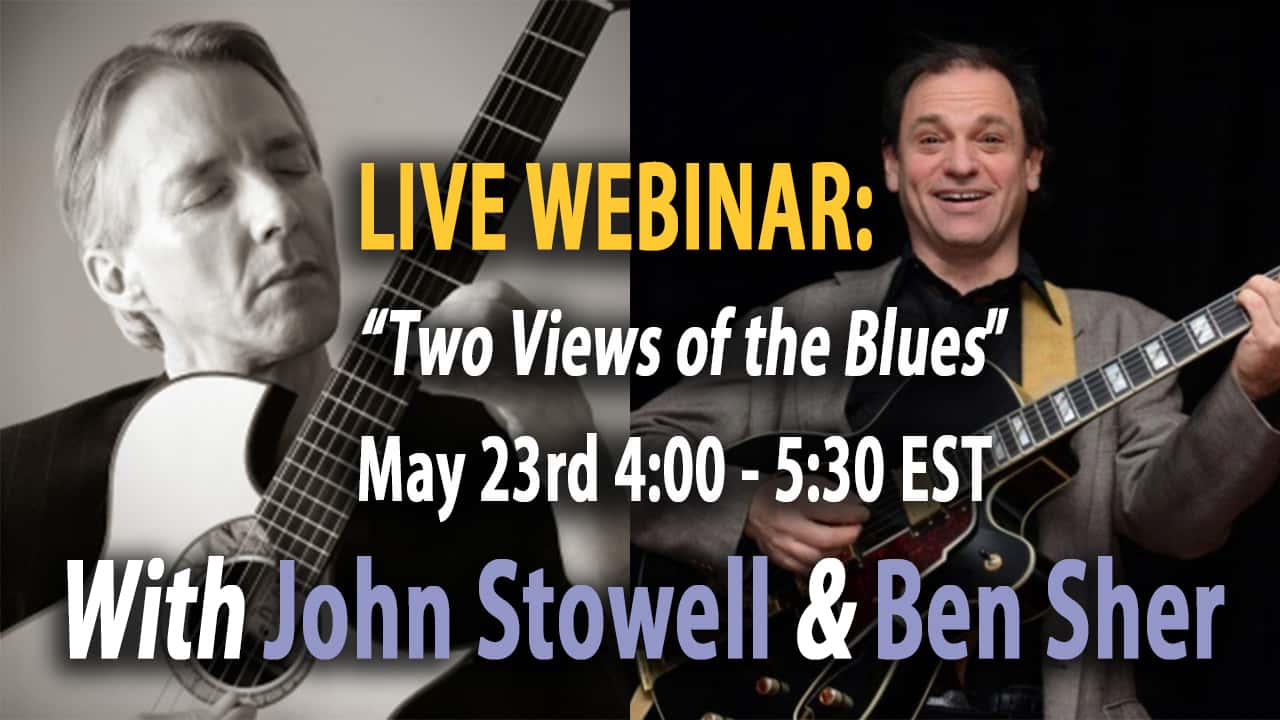
Two Views of the Blues: John Stowell & Ben Sher Webinar [May 23rd 4:00 - 5:30 EST]
Masters Ben Sher and John Stowell present a webinar, playing and discussing their ideas on the blues: everything from blues scales to basic bebop substitutions to modal McCoy Tyner style harmonies, and of course each of these two guitarists unique styles as applied to blues changes. This should be a great encyclopedic exploration! Level: Intermediate
John Stowell & Mike Godette Class #6: Reharmonization Strategies on "Feire Livre"
Using the pianist/composer Jovino Santos Neto’s tune “Feire Livre”, John and Mike explore some non-diatonic harmony, specific dominant tensions and resolutions and voice leading. Also covered are extensions of minor tonalities and references to implied V chords in soloing. John and Mike also trade some choruses on “Feire Livre” to demonstrate the concepts they have discussed. Sub-topics: 1 Brazilian Baione rhythms 2 Melodic minor modes and tonalities 3 Internalizing harmonic information Categories: Chord Voicings Harmony Modern Jazz Guitar Soloing Theory Student Outcome: Improved improvisation skills and voice leading concepts. Level: Advanced
Soloing and Reharmonization Strategies for Standards
Using the standard “Gone With the Wind”, John and Randy trade choruses, reacting to each other’s approach to harmony and soloing. Specific topics of discussion include implied time, displaced rhythms, voice leading and improvised chord melody. Also covered are diads, contrary motion, pianistic and drop 2 voicings and altered dominant chords. John and Randy also alternate choruses of comping to demonstrate accompaniment techniques. Sub-Topics: Importance of the use of space in soloing and comping Moveable shapes used as altered dominant chords Motific development in solos. Categories: Chord Melody Chord Voicings Harmony Modern Jazz Guitar Soloing Expected Outcome: The student will have new ideas regarding variations on standard diatonic progressions and new chord voicings and solo lines. Level: Advanced
Reharmonization and Modulation Strategies 5
Using the standard “You and the Night and the Music” as a vehicle, John and Mike demonstrate an arrangement in two keys and discuss the benefits of using modulation as a device to internalize and memorize chord progressions. John and Mike also reference some melodic and harmonic chord voicings to access tensions over major and dominant chords. Sub-Topics: Playing over the bar line to develop asymmetrical phrasing Improvising with a pulse and no fixed meter Chord shapes as templates for single line improvising Categories: Chord Voicings Comping Harmony Modern Jazz Guitar Theory Expected Outcome: Have motivation and skills to create modulations in arrangements and improve memorization and transposing abilities.
Modes of the Harmonic Minor as Applied to Major Chords (#4)
In this 4th installment of John and Mike's Reharmonization and Modulation series they break down the Harmonic Minor Scale and how it can be applied to Major tonalities and how they can be applied to chord voicing's and improvisational ideas. Sub-Topics: Utilizing the #9 over Major tonalities Superimposing Triads within the Harmonic Minor Scale over Major tonalities Weaving in and out of Major and Harmonic Minor tonalities Variations within triads to change the sound of the tonality Expected Outcome: To have a new set of sounds and colors to help expand your possibilities of what to play over Major7 tonalities. Improvising with a pulse and no fixed meter Chord shapes as templates for single line improvising Categories: Chord Voicings Comping Harmony Modern Jazz Guitar Theory Expected Outcome: Have motivation and skills to create modulations in arrangements and improve memorization and transposing abilities.
Modes of the Harmonic Minor as Applied to Minor and Dominant Chords (#3)
In this 3rd installment of John and Mike's Reharmonization and Modulation series they break down the Harmonic Minor Scale and how it can be applied to Minor 7 and Dominant 7 tonalities and how they can be applied to chord voicing's and improvisational ideas.
Reharmonization Strategies/ Conversation with John Stowell and Micky Lee/Part 1
In this class, John and Micky use the well known standard “Have You Met Miss Jones” to demonstrate a number of important concepts regarding comping, soloing and reharmonization of the basic diatonic harmony of the song. Double stops (two note voicings), and voice leading are also demonstrated; in addition, John and Micky discuss the importance of space, compositional intention and the utilization of the melody to internalize the form. Sub-topic 1: Using specific rhythmic values to develop comping skills Sub-topic 2: The use of double stops and counterpoint in comping Sub-topic 3: The importance of space and compositional intention when soloing. Expected outcome from class: Develop new skills in areas of comping, soloing and basic reharmonization of diatonic progressions.
Strategies for Chord Melody, Voice Leading and Comping, Part 2
An advanced discussion on improving chord melody, voice leading and reharmonization skills. In this class, Sheryl and John use “Embraceable You” to demonstrate the use of open string voicings, chord melody and voice leading in accompaniment and soloing. Also referenced are diminished chords interpreted as altered dominant chords and importance of melody to create context for improvisation. Sub-topic 1 Use of open string voicings Sub-topic 2 Using chord melody arrangements as a context to develop voice leading Sub-topic 3 The importance of original sheet music to discover harmonic variations. Categories: Chord Melody Chord Voicings Comping Harmony Standards
Strategies for Developing Chord Melody, Comping, Reharmonization Ideas
An advanced discussion for improving comping, voice leading and reharmonization skills. In this class, Sheryl and John use the standard “I Should Care” as a vehicle to explore reharmonization of the basic diatonic cadences of the tune. Also covered are comping concepts, voice leading, and broader applications of variations on diatonic harmony. Sheryl and John also trade solo and comping choruses and 8s to demonstrate the topics discussed. Sub-topic 1 Use of block chords and pianistic concepts in comping Sub-topic 2 Importance of the melody of a tune for create context for soloing and internalizing the form. Sub-topic 3 Mindfulness of context to use appropriate chords and harmony for soloing and comping. Categories: Chord Melody Chord Voicings Comping Harmony Standards
Conversation with John Stowell and Genil Castro, Part 2: Further Discussion of Bossa Nova, Samba and Harmonic Strategies Using Reharmonization and Melodic Minor Modes
Genil explains his reharmonization of the intro to “Dindi”; John and Genil both demonstrate the use of melodic minor chords as dominant chords and the broader applications of this harmony in other contexts. Also covered are some strategies for improvising over non-diatonic progressions and the use of rhythmic motifs in solos.
How Deep is the Ocean? Pt. 4: John Stowell and Tim Lerch Jazz Guitar Conversations
John and Tim's discuss part 3 of the standard "How Deep is the Ocean?" Master's View on Improvising Gain insight into how professional players approach a standard tune harmonically, rhythmically and conceptually. Topics Include: Chord Melody Chord Voicings Comping Harmony Mindfulness Modern Jazz Guitar Practicing Rhythm Soloing Standards Theory Chord soloing Learning tunes
Conversation With John Stowell and Genil Castro, Part 1: Discussion of Samba, Bossa Nova, Brazilian Rhythms, Harmony and Chord Progressions
In this class, John and Genil use the well known tune “Triste” from Tom Jobim to demonstrate rhythms used in Bossa Nova and Samba . Also covered are voice leading, chord inversions, movable chord shapes, artificial harmonics, double stops and open string voicings. Genil and John demonstrate how chord shapes are also useful as templates on the neck to generate single line ideas for soloing. The modes of the melodic minor are also referenced to introduce tensions/embellishments over dominant, minor and half diminished chords.
Strategies for Reharmonizations and Solo Guitar Techniques
Find new ways to negotiate progressions and internalize re-harmonization ideas. In this class, John and Sean initially trade choruses on “Alone Together”, demonstrating pedal points, voice leading, double stops, open string voicings, and re-harmonization ideas on common cadences and turnarounds. Other topics referenced include the importance of melody to internalize song form and as a reference and context for improvisation. Implied time versus obviously stated rhythm is also demonstrated. Sub-topic 1 Different approaches to solo guitar Sub-topic 2 Rhythmic subdivisions and internalizing time and form Sub-topic 3 Importance of space as a creative element of improvising. Categories: Chord Melody Chord Voicings Comping Harmony Modern Jazz Guitar
Out of Nowhere: Solo Guitar, Harmonic, and Melodic Approaches
John Stowell and Tom Lippincott play and discuss their approaches to the standard "Out of Nowhere" in a Zoom conversation. Gain a better understanding of applying melodic and harmonic ideas to the song Out of Nowhere which can also be applied to other standards and jazz tunes. Some of the topics covered in this discussion include: • Trading sixteens, eights, and fours improvising solo guitar • Solo guitar melody statement and discussion of the approaches • Comparison and contrast between John’s and Tom’s approaches to the song and to improvising • Breaking down the form of the song • Harmonic analysis of the chord changes with discussion • Taking the melody into account with harmonic and single-note improvisational approaches • Discussion of incorporating open strings in both chord voicing and single-note lines • Discussion of different chord substitutions including tonic diminished and other possibilities using modes of harmonic and melodic minor scales • Taking the song to a different key to demonstrate the importance of thinking of the function and relationships of the melody and harmony • Includes 39 pages of articles and transcriptions from John Stowell • Also includes a three-page PDF put together for this class detailing the harmonic analysis discussed plus a few of the specific chord voicings demonstrated Categories: Chord Melody Chord Voicing Harmony Soloing Standards
A Creative Approach to Standards pt 2: Nobody Else But Me
In Part 2 of their conversation, John and Jamie use “Nobody Else But Me” (Jerome Kern’s last song) as a context to discuss variations on standard diatonic harmony and the use of the melody as a way to internalize form and create motific solos. Other topics covered include modulations, open string voicings, diminished chords referenced as altered dominant chords, and broader applications of cadences to apply to other tunes. In addition to their interpretations of the melody, John and Jamie also exchange choruses and fours over the changes To “Nobody Else But Me” and discuss the harmony to this beautiful but obscure standard.
A Creative Approach to Standards pt.1: Someday My Prince Will Come
In this class, John and Jamie use the familiar chord progression to "Someday My Prince Will Come" to explore the modes of the melodic and harmonic minor. There are specific references to these modes as they apply to altered dominant chords, and tonic diminished as Lydian #9 harmonies. There are also references to triads and right hand technique in John and Jamie's discussion. The harmony covered has broader applications beyond this one song, as portions of the progression occur in many other standards. A PDF of the tune is provided with the class.
Demonstration of Harmonic Minor Modes Over Dominant Chords #3
For this class, John and Mike cover the four modes of the harmonic minor that generate different combinations of tension over a dominant chord. Harmonic minor chords referenced and used as dominant chords in a V-I setting are also discussed and demonstrated. These applications will give the student access to many new colors and harmonic choices when soloing over the dominant chord and using tensions to create resolution.
Demonstration of Harmonic Minor Modes Over Major, Minor and Diminished Chords #4
In this class, John and Mike continue their demonstration of the harmonic minor modes, in this case discussing the tensions created over major, minor and diminished chords with harmonic minor chords and arpeggios combined with basic major, minor and diminished (as altered dominant) harmony. Specific references include the lydian #9 major harmony generated by the 6th mode of the harmonic minor, as well as the various tensions created over minor and major chords. Implied V chords using harmonic minor modes are also referenced, reinforcing material covered in previous classes.
Thoughts on Composing, Chord Melody and Voice Leading
In this class, John and Kevin discuss and demonstrate their approaches to composing, chord melody and voice leading. In the course of their conversation, John plays several of his original compositions and breaks down the harmony of each piece. Both men emphasize the necessity of learning new chords in the context of an arrangement to be able retain new voicings. Also covered in the discussion are modes of the melodic and harmonic minor as they apply to altered dominant chords and harmony. In their informal conversation and reaction to each other’s playing and examples, John and Kevin provide many pragmatic tools for the student to expand and develop new vocabulary and composing skills. Included in the class is a pdf containing a number of original compositions from John. 21 min 5 pages of pdf
Discussion/Demonstration of the Modes of the Melodic Minor Over Dominant Chords
In this class, John and Kevin demonstrate their different but complimentary approaches to the four modes of the melodic minor scale that introduce tensions over a dominant chord. Also covered in the discussion are applications of melodic minor chords as dominant chords and the use of tension/resolution in a II-V-I setting. Included in the class is a 39 page pdf with articles written by John. In their informal conversation, John and Kevin’s examples will give the student access to many hands-on tools for developing and expanding altered dominant vocabulary and sounds. 34 min 39 pages PDF included
Modes of the Melodic Minor as Applied to Major and Minor Chords (#2)
For this class, John and Mike continue their conversation of melodic minor modes,; in this session, modes which cover major and minor tonalities are demonstrated, using melodic minor arpeggios and chord voicings as extensions of major and minor harmony. Also covered are applications of melodic minor and dorian minor sounds. This is session II from Mike and John. Mike Godette: Mike Godette is a guitarist out of the New Haven, Connecticut area. In his formative years he studied classic rock and metal and then started gradually getting more and more interested in fusion music. Through fusion his interest in jazz grew more and he enrolled in an arts high school in New Haven called Educational Center For The Arts where he studied for his junior and senior year. After graduating high school he enrolled in Western Connecticut State University and received a degree in Jazz Studies. For the past decade, Mike has had an active teaching and performing schedule. He's toured all over the country with his former progressive jazz metal group Mid Atlantic Title, and he's also performed with jazz artists such as Aaron Goldberg, Myron Walden, Jimmy Greene, Jumaane Smith and Ralph Lalama. Mike is currently on the faculty of the Litchfield Jazz Camp, Fairfield School of Music and Continuo Music. In addition to teaching, Mike is currently working on collaboration lesson videos with other guitarist's as well as maintaining an active youtube channel.
Modes of the Melodic Minor as Applied to Dominant Chords (#1)
In this class, John and Mike demonstrate how the melodic minor modes over dominant chords can be applied to create tension/resolution in a V-I setting. Also discussed are melodic minor chords referenced as dominant altered chords and implied V chords as a reharmonization device. Some pianistic chord voicings for the guitar are also demonstrated. This is Session I from Mike and John. Mike Godett: Mike Godette is a guitarist out of the New Haven, Connecticut area. In his formative years he studied classic rock and metal and then started gradually getting more and more interested in fusion music. Through fusion his interest in jazz grew more and he enrolled in an arts high school in New Haven called Educational Center For The Arts where he studied for his junior and senior year. After graduating high school he enrolled in Western Connecticut State University and received a degree in Jazz Studies. For the past decade, Mike has had an active teaching and performing schedule. He’s toured all over the country with his former progressive jazz metal group Mid Atlantic Title, and he’s also performed with jazz artists such as Aaron Goldberg, Myron Walden, Jimmy Greene, Jumaane Smith and Ralph Lalama. Mike is currently on the faculty of the Litchfield Jazz Camp, Fairfield School of Music and Continuo Music. In addition to teaching, Mike is currently working on collaboration lesson videos with other guitarist’s as well as maintaining an active youtube channel.
John Stowell and Tim Lerch Jazz Guitar Conversations #1
Do you ever wonder what two Jazz guitar masters talk about when they are just hanging out and enjoying each others company? Join John and Tim in an wide ranging and enlightening conversation on the subjects of Jazz improvisation, learning strategies and more. About Tim Lerch World renowned guitarist and educator, Tim is a member of the legendary Northwest Gypsy Jazz Group Pearl Django and popular duo with Jamie Findlay. In between gigs with PD and Jamie, Tim tries to play as many Solo Guitar performance as he can fit into the schedule.
How Deep is the Ocean? Pt. 1: John Stowell and Tim Lerch Jazz Guitar Conversations
Do you ever wonder what two Jazz guitar masters talk about when they are just hanging out and enjoying each others company? Join John and Tim in an wide ranging and enlightening conversation on the subjects of Jazz improvisation, learning strategies and more. About Tim Lerch World renowned guitarist and educator, Tim is a member of the legendary Northwest Gypsy Jazz Group Pearl Django and popular duo with Jamie Findlay. In between gigs with PD and Jamie, Tim tries to play as many Solo Guitar performance as he can fit into the schedule.
How Deep is the Ocean? Pt. 2: John Stowell and Tim Lerch Jazz Guitar Conversations
Do you ever wonder what two Jazz guitar masters talk about when they are just hanging out and enjoying each others company? Join John and Tim in an wide ranging and enlightening conversation on the subjects of Jazz improvisation, learning strategies and more. About Tim Lerch World renowned guitarist and educator, Tim is a member of the legendary Northwest Gypsy Jazz Group Pearl Django and popular duo with Jamie Findlay. In between gigs with PD and Jamie, Tim tries to play as many Solo Guitar performance as he can fit into the schedule.
Modulation as an Arranging Technique
Are you bored of jazz standards? Are you bored at least of playing those songs the same way each time? Wouldn't it be great to have a creative way of approaching those familiar tunes? So many songs are played the exact same way at every gig! Same tempos, same keys. It can get boring after awhile. For touring jazz guitar master John Stowell, one of his personal approaches to keeping jazz standards fresh is by purposely creating arrangements that include modulations. It’s not just about modulating but also about considering the color and relationship between the two keys (or more) in your arrangement. In this master class, you will see how John applies this concept to 3 beautiful compositions: The Day of Wine and Roses You And The Night And The Music Isfahan On the standard, The Days of Wine and Roses, watch as John goes through the chord changes and his personal voicing choices for his take on this tune. Then, discover how John plays his arrangement of this piece in two keys. He then explores the two other tunes in a similar way. Learn these wonderful pieces directly from John and add them to your repertoire today! If you want to get your arrangements of jazz standards to be more interesting or challenging, this musical exploration of modulation will multiply your mastery. You will find out how playing songs in different keys adds a unique dimension to familiar standards. In addition to the main lesson, you will also receive “The John Stowell Real Book”. This is a 19-page collection of John’s personal favorites, including handwritten arrangements and reharmonized changes to his favorite songs. If you’ve ever met or performed with John, you’ve probably seen at least parts of this collection before. If you haven’t met John in person, this is a treasured resource that you can use to apply the concepts covered in this master class. Learn the songs here for your own shows and also for your future jams (perhaps even with John Stowell himself!). Suitable for intermediate and advanced guitarists, this masterclass will help you add another dimension to your arrangements immediately. This is a practical class that you can digest the concepts quickly in 28 minutes. Then, you can revisit your favorite segments to learn John’s voicings or lines on those tunes. Get the "key" to another level of creativity and modulate now! 19 Pages of PDF materials in standard notation (lead sheet style) Full video is 28 minutes
Exploring Original Compositions, pt 2
A sequel to John’s excellent initial Exploring Original Creations masterclass, this new masterclass will help you discover colorful rich voicings, expand your ears and develop your solo guitar skills. Although learning voicings separately is important, nothing beats hearing (and understanding) how a master applies challenging ear (and finger) stretching sounds in a musical context. John Stowell shares insights on how he creates harmonically dense and beautiful original compositions. This is not to just teach you cool chord voicings but to give you the tools for you to use in your own performances. By learning John’s pieces, you will be able to quickly digest many chords in context so that you can apply them in your compositions and arrangements. Every chord voicing, double stop and single note is explained and broken down so that you know where each note comes from. John is a patient and dedicated educator who shares his thought process for these three beautiful pieces. In addition to explaining how he performs each piece as a solo guitar piece (using his signature pianistic approach), he also performs an improvisation on the blowing changes. These soloing chord changes are also included so you can see how John simplifies the chord progression so that the piece is more friendly for soloing. If you'd like to start including more modern harmonic colors in your playing, this is a great masterclass for you. 12 Pages of PDFs Included Running Time: 53 mins


![Two Views of the Blues: John Stowell & Ben Sher Webinar [May 23rd 4:00 - 5:30 EST]](/_next/image?url=https%3A%2F%2Fqhlkq2o3dsooucxb.public.blob.vercel-storage.com%2Fcourse%2F1758143028313-aosrf-two-views-of-the-blues-john-stowell-ben-sher-2.jpg&w=3840&q=60)


