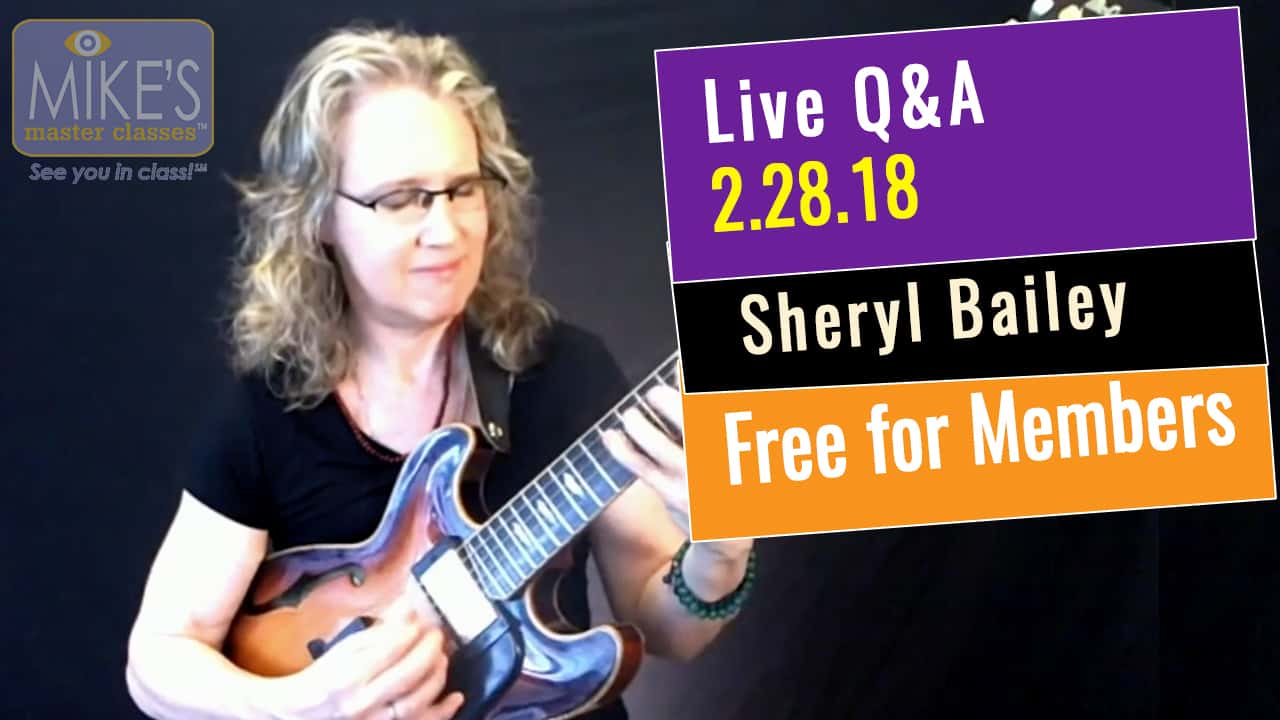
Sheryl Bailey

Sheryl Bailey

Jazz Guitar Master

12 Courses
2,964 Students
4.7 Rating

All Courses by Sheryl Bailey

12 courses
Sheryl Bailey Live Q&A 2/28/18 at 8pm EST [Free for Members]
Free for Members

Sheryl Bailey Live Q&A 2/28/18 at 8pm EST [Free for Members]

There's no description more apt for Sheryl Bailey than "A sizzling guitar goddess", coined by Elliot Simon of All About Jazz . He's not alone with his superlatives-Adam Levy of Guitar Player Magazine calls Sheryl "One of the most compelling tones of her generation", and Frank Forte of Just Jazz Guitar ranks her "among the best bop guitar players with a fresh approach and something new." FREE FOR MEMBERS Sheryl's playing is unquestionably "sizzling". She has groomed incredible chops and impeccable taste with which she applies them. It's said (by Lee Metcalf, The Villager ) that she can "go from zero to blazing in two beats", but she is continually praised for never sacrificing melody and lyricism for technique. "She balances superior technical skills with a strong lyrical sense and swinging touch..." continues Metcalf, and Joe Taylor of Soundstage says "Bailey combines an astonishing command of the fingerboard with a seemingly endless flow of melodic invention." Sheryl Bailey's Full Bio

Jazz GuitarLive Q&AImprovisation
1 lessons
$9.95
Members save 20%
1 credit
5.0 (1 reviews)
View Course
Pluralities: Exploring Families of Chord Expansions

Pluralities: Exploring Families of Chord Expansions

For those who missed this class by Sheryl earlier, she's doing it again! She'll be sharing her concepts of exploring chord families to create modern harmonic concepts during soloing and comping.

HarmonySoloingModern Jazz Guitar
1 lessons
$12.95
Members save 20%
1 credit
3.7 (3 reviews)
View Course
Melodic Embellishment

Melodic Embellishment

Those who attended Sheryl's first couple classes are looking forward to another idea-packed session! Sheryl will demonstrate exploring creating melodies from chord structures - aka: approach tones. View clip from this class

HarmonySoloingTheory
1 lessons
$14.95
Members save 20%
1 credit
4.5 (6 reviews)
View Course
Melodic Minor Madness

Melodic Minor Madness

How to expand your chordal palate and melodic lines by converting to min/ma7 voicings from the Jazz Melodic Minor scale. I will show how the min/ma7 relates to all of the common chord functions: I minor, I major, II subdominant, V7 w/ natural tensions, and V7 w/ altered tensions. By using each function in context of the common II-V-I progression, students can open their ears and create more modern sounding voicings. I'll then apply each concept over a standard tune to demonstrate how the harmony opens up. Having a wide vocabulary of ways to voice the melodic minor sound will open the door to using it for inventing lines.

HarmonySoloingTheory
1 lessons
$8.95
Members save 20%
1 credit
5.0 (1 reviews)
View Course
Concert/Clinic - Classic Duo with Two Jazz Masters Sheryl Bailey & Jack Wilkins

Concert/Clinic - Classic Duo with Two Jazz Masters Sheryl Bailey & Jack Wilkins

Step into Jack Wilkins' living room for an intimate masterclass where two distinguished jazz guitarists share decades of professional wisdom in this rare 2006 concert-clinic recording. This unique session captures Wilkins and Sheryl Bailey performing classic jazz standards while fielding real-time questions from viewers, offering unprecedented insight into the techniques that define masterful jazz guitar performance. Throughout this interactive experience, you'll witness firsthand demonstrations of advanced harmonic techniques, including Jack's detailed breakdown of artificial harmonics across multiple octaves—from basic execution to sophisticated applications in minor 9th and dominant 9th voicings. Sheryl Bailey reveals her revolutionary picking approach, explaining how she transformed her tone by adopting George Benson-inspired techniques learned from Rodney Jones, achieving the lighter touch essential for both speed and tonal clarity. The duo performs seven carefully selected standards including "Gone with the Wind," "Tenderly," and Chick Corea's challenging "500 Miles High," demonstrating real-world applications of the discussed techniques. Between performances, they address crucial technical questions about pick angle, alternate versus consecutive picking methods, and the subtle wrist mechanics that separate professional execution from amateur attempts. Perfect for experienced players seeking to refine their duo performance skills, understand the nuances of harmonic voicings, or develop more sophisticated picking techniques. You'll gain practical insights into adapting your technical approach based on musical context—knowledge that typically takes years of professional performance to acquire.

SoloingStandards
2 lessons
$7.95
Members save 20%
1 credit
View Course
The Art of the Duo

The Art of the Duo

Join Sheryl and her great friend and guitarist Chris Bergson. The two of them have a special duo collaboration. They will get into the different rhythm styles, comping, voicings and playing lines, feeling time, etc. Chris is also an incredible down-home blues player, so expect them to do some jammin' on the blues, too. View clips from this class

CompingIntroductions and EndingsRhythm+1
1 lessons
$9.95
Members save 20%
1 credit
3.0 (1 reviews)
View Course
Bebop Flow: Connecting Harmonic Concepts with the Family of 4
Bestseller

Bebop Flow: Connecting Harmonic Concepts with the Family of 4

Learn how to play in any harmonic situation and create long, fluid lines with this concept of applying the Dom7 Be-bop Scale with a group of chord substitutions called "The Family of 4". The Bebop Flow course, taught by renowned jazz guitarist Sheryl Bailey, is an in-depth exploration of the harmonic concepts that underpin bebop and how they can be connected through the use of the "family of 4" approach. The course is aimed at intermediate to advanced guitarists who want to develop a deeper understanding of the harmonic structures used in bebop and learn how to create flowing melodic lines that connect these structures. Throughout the course, Sheryl Bailey breaks down key concepts such as the bebop scale, chord tones, and chord progressions, providing detailed explanations and demonstrations of how these concepts can be used to create fluid lines that connect the harmony. The course is divided into four main sections, each of which focuses on a different aspect of the bebop flow approach: Building Blocks - In this section, Sheryl Bailey introduces the key harmonic concepts that underpin the bebop flow approach, including the bebop scale, chord tones, and chord progressions. Family of 4 - The family of 4 approach is a powerful tool for connecting harmonic concepts and creating flowing lines. In this section, Sheryl Bailey teaches you how to use this approach to create melodic lines that connect the harmony. Turnarounds - Turnarounds are an essential part of jazz harmony, and in this section, Sheryl Bailey teaches you how to use the bebop flow approach to create flowing lines over common turnaround progressions. Practical Application - In the final section of the course, Sheryl Bailey demonstrates how the concepts covered in the course can be applied in a practical setting, showing you how to use the bebop flow approach to create solos over a variety of jazz standards. The course includes detailed video lessons, downloadable practice materials, and backing tracks to help you practice and apply the concepts covered in the course. Whether you're an intermediate guitarist looking to develop your understanding of jazz harmony or an advanced player looking to take your solos to the next level, the Bebop Flow course is an essential resource for any guitarist looking to master the bebop language. "Sheryl Bailey shares her approach to practicing and developing strong sounding bebop lines and gives specific examples to demonstrate the concept. This is a lesson from a real performer so it’s real practical application rather than just theory! Some bebop lessons that I’ve encountered at times tend to be dry and removed from the melodic flow and intensity of the real music." ~ Az Samad "Sheryl lays out the material in a very intelligent & organized manner! Her concept is nothing short of brilliant." ~ Steven Larcovic "I think this is simply the best instructional video I’ve ever seen. Very practical, very clear, sick lines. Sheryl is just an amazing teacher who not only teaches very well but plays smoking lines too. By the end of the video you finally understand the concept of substitions and how to play the bebop scale. Get this!" Read a full review of this class in Guitar International Magazine "Sheryl Bailey, in addition to being an outstanding musician and performer, does a great job of communicating concepts to students. Application of the Micro-cosmic bebop line to the family of 4 plus 1 chords came very easily after taking this lesson. I started working the line into ii-Vs in a bunch of tunes my quartet performs. This is how I run through keys, by pushing myself to use new ideas in tunes. The application to tritone subs was excellent. Great lesson...thanks!" ~ Mark B. "This is a great lesson for anyone who wants to understand the Bebop language with easy and fast. Results are immediately practical. Sheryl founded a way to make it really simple and understandable. 5 chords and just one dominant Bebop scale and you're ready to go for it. Thanks Sheryl you did a great job, we're waiting for part two." ~ Chris "Another great insight from Sheryl. I have been working with the Bebop scales for awhile and were hit and a lot of miss, but this lesson put's it all into perspective and now getting some great new sounds in my lines. " ~ Steve B.

HarmonyRecently Enhanced ClassSegment Enhanced+2
32 lessons
$29.95
Members save 20%
1 credit
5.0 (10 reviews)
View Course
Bailey's Boot Camp Basics - Part II

Bailey's Boot Camp Basics - Part II

Master the essential voicing techniques that separate professional jazz guitarists from the rest in this comprehensive exploration of drop-3 voicings and walking bass-chord style with acclaimed guitarist and educator Sheryl Bailey. Building on foundational fretboard concepts, this course dives deep into the practical application of drop-3 inversions across all four positions of the neck, transforming how you approach both chord voicings and melodic lines. You'll develop the coveted walking bass-chord style that made Bailey a sought-after duo partner throughout her Berklee years and beyond—a skill that transforms any guitarist into a self-contained rhythm section. Through systematic exercises using minor blues progressions and the Miles Davis classic "Tune Up," you'll learn to voice-lead through complex harmony while maintaining that steady quarter-note pulse that defines authentic jazz comping. Bailey demonstrates how to connect chord voicings directly to improvised lines, showing how each drop-3 position creates a framework for melodic exploration within specific fretboard blocks. You'll work through practical applications including chromatic approach tones, voice-leading through II-V-I progressions, and the crucial skill of comping without always placing roots in the bass—opening up more sophisticated harmonic possibilities. Perfect for intermediate players ready to break free from basic chord grips and develop the fluid, interconnected approach that working jazz guitarists use nightly. These techniques form the foundation for duo playing, small group comping, and solo guitar arrangements that sound full and professional.

HarmonyTheory
1 lessons
$8.95
Members save 20%
1 credit
View Course
Bailey's Boot Camp Basics

Bailey's Boot Camp Basics

Master the essential framework that separates accomplished jazz guitarists from perpetual students with Sheryl Bailey's systematic approach to fretboard mastery. This comprehensive bootcamp delivers the fundamental skills every serious jazz guitarist needs, starting with Bailey's revolutionary "12-Key Grip" system—a methodical approach that unlocks fluency across all twelve keys using seven strategic fingering positions. Bailey, drawing from her extensive performance career and years of teaching at Berklee, breaks down the three parental scales—major, jazz melodic minor, and harmonic minor—that generate the 21 scales essential for jazz improvisation. You'll discover how to organize the fretboard logically, moving beyond memorized patterns to true understanding. Learn to navigate key changes seamlessly, just as Bailey demonstrates on Benny Golson's "Along Came Betty," where the harmony shifts every bar. This isn't another generic scale exercise collection. Bailey emphasizes the critical importance of consistent fingering, proper hand positioning, and the slow, deliberate practice that builds the muscle memory professional players rely on. You'll explore practical applications of scales and modes, understand intervallic relationships, and develop the ability to visualize all available notes within any five-fret span—a skill that transforms your improvisation from position-based playing to true fretboard freedom. Perfect for intermediate players ready to break through plateaus, or advanced guitarists seeking to solidify their theoretical foundation. Bailey's clear, no-nonsense teaching style delivers the tools you need to approach any jazz standard with confidence and authority.

TheoryTechnique
1 lessons
$7.95
Members save 20%
1 credit
5.0 (2 reviews)
View Course
Bailey's Boot Camp Basics - Part III

Bailey's Boot Camp Basics - Part III

Master the essential voicings that define modern jazz guitar with Sheryl Bailey in this comprehensive exploration of drop 2 chord voicings and their applications. Building on the fundamentals from her previous Boot Camp sessions, Bailey reveals the professional techniques that shaped the sounds of Wes Montgomery and continue to distinguish today's working jazz guitarists. This systematic approach to drop 2 voicings breaks the fretboard into manageable sections, teaching you to navigate all three string sets—high, middle, and low—with confidence. You'll learn to transform basic ii-V-I progressions into sophisticated harmonic statements by adding extensions like 9ths, 11ths, and 13ths, while discovering how to use passing diminished chords to create seamless voice leading between inversions. Bailey demonstrates practical comping patterns that work in real performance situations, from supporting horn players to crafting compelling chord solos. Beyond the mechanics, you'll develop crucial skills for personalizing your sound through strategic use of tensions and alterations on dominant chords. The course emphasizes the bebop tradition while showing how these voicings remain relevant in contemporary jazz contexts. Bailey's methodical approach includes left-hand conditioning exercises and melodic chord studies that build both technique and musical understanding. Whether you're looking to enhance your comping vocabulary, develop chord-melody arrangements, or simply understand the harmonic foundations that professional jazz guitarists rely on, these drop 2 concepts provide the framework for years of musical exploration and growth.

Chord VoicingsHarmonySoloing+1
1 lessons
$7.95
Members save 20%
1 credit
5.0 (1 reviews)
View Course
Bebop Flow Part 2: Combining Families for Altered II V's

Bebop Flow Part 2: Combining Families for Altered II V's

Sheryl Bailey continues her series on Bebop Flow , where she teaches how to play in any harmonic situation and create long, fluid lines with this concept of applying the Dom7 Be-bop Scale with a group of chord substitutions called "The Family of 4". In this class, she shows how to combine families for altered II - V's. It includes a review, or introduction if you have not viewed the first class, of the Dominant 7 Bebop scale along with new concepts and written materials in standard notation. Read a review of the first class in Guitar International Magazine "A MUST!! THIS LESSON WILL OPEN DOORS IF YOU'RE STRUGGLING WITH II V I'S AND JAZZ VOCABULARY. It’s a systematic way to navigate through changes that are the backbone of most jazz standards. At first glance, it seems complicated, but upon reflection it’s quite easy to grasp I look forward to future lessons with SB."

HarmonySoloingImprovisation
1 lessons
$34.95
Members save 20%
1 credit
5.0 (4 reviews)
View Course
"Naima" - Exploring Modern Dominant 7ths

"Naima" - Exploring Modern Dominant 7ths

"'Naima' is a gift", Sheryl Bailey explains about one of John Coltrane’s most stunning compositions, a tune of kaleidoscopic, evolving colors which rotates through the family of dominant seventh chord sounds. Coltrane composed this ballad in 1959 "Naima" naming after his wife. He first recorded it on the album "Giant Steps" and is notable for its use of a rich harmonies over a bass pedal notes. It has been covered by a range of musicians such as McCoy Tyner, John McLaughlin, Jaco Pastorius and Herbie Hancock. Sheryl Bailey likens these tonal changes to a cloudy sky going through both bright and dark moods. This helps the guitarist to intuitively navigate with both chordal and single-note playing. This course helps the guitarist to understand the song in terms of its use of the four main types of seventh chord sounds and scales it uses: Dominant sevenths, Diminished, Altered dominant and Natural /’sus’ dominants. Refreshingly, she offers a range of ideas to balance the intellect and intuition, helping the guitarist to feel their way through each chord group. Her enthusiasm and love for playing with feel is contagious. Watching her love of the music will be a pleasant surprise in terms of learning one of Trane’s deepest and most mystical songs. There is an emphasis on working with harmonies and melodies as she breaks the song apart. She beautifully demonstrates how to navigate the song by vamping over loops of each of the four dominant chord types within “Naima”. Her demonstration over these loops creates joyful, big open opportunities for both your chordal and single-note explorations. The joy of listening to her playing over a chord-at-a-time will be inspirational to the viewer. In this course is a good mix of humor and surprising sights into the playing of others as well as a range of useful tips such as: 2-5 applications, Tritone substitutes approaches Harmonic information (i.e., did you know that the Harmonic Major uniquely contributes to the “modern jazz sound” of players such as Adam Rogers and Kurt Rosenwinkel?) References to George Russel’s ‘Lydian Harmonic Concept”. ( explaining how major and minor chords differ in jazz approaches compared to classical) Sheryl presents this information in a way that is fun and will help you to immediately apply new ideas not only to Coltrane's composition, but to your overall rhythm, improvising and compositional approaches.

Chord MelodyChord VoicingsComposition+6
1 lessons
$12.95
Members save 20%
1 credit
4.7 (3 reviews)
View Course